|
 FRANCAIS
beginnings
specification
site
modelling
changes
self
build
ecological building
Energy
consumption 
Costs
design
progress ( # weeks)
latest
photos 2012 - 13
160-200
summer/autumn 2011
122-160
Spring 2011
92-122
after moving in
91
moved in at last
90 stair, drive, rw drain
85-89 joinery, stair, more
snow
81-84 help insulation
snow
75-80 tiling painting
snow
71-74 interiors and cistern
65-70 EDF problems etc
64 ground floor finishing
63
mezzanine finished
62 mezzanine finishings
61 joinery, painting
60 external final crépis
59 electrical connection
58 interiors mezzanine
57 external render (crépis)
56 plumbers back
49-55 kitchen garage
doors
41-48
joinery floors etc
40
floors solar water heating
39
electrians plumbers
38
new year - help
37
garage tiled, heating on
36
roofing garage
35
mezzanine, tidying up around house
34
garage walls
33
floors, garage foundations
32 cladding, floors
31 grouting, cleaning
30
floor tiling
29
front door, tank, fireplace
28 stair,
floor framing
27 pipes,
screeds
26 underfloor
heating
25 chimney,
flue
24 more
self build
23 masons,
septic tank
22 new
machine
21
plastering
17-
20 electricity, insulation
16
last windows
15
self-build again
14
first windows fitted
13
self build, details
12
external cladding
11 purlins and roof tiling
10 erection of frames
9
making trusses
8
ring beam
7 monomur walls
6 floor beams
5 basement walls and monomur
4 crane
3 ground slab
2 foundations
1 earthworks
FRANCAIS
(Traduction Google)
Firefox
Internet
Explorer
|
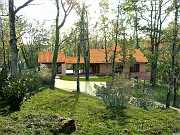
Building
a solar house in France is a challenge, even for an architect,
and beginning another self-build project at the age of 72
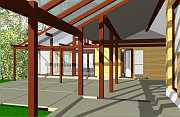
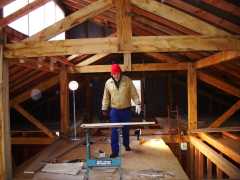
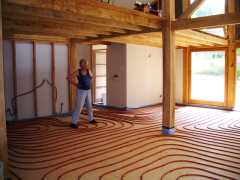
is a bit of a challenge too. This is a picture record - a
plog rather than a blog - a series of 'albums' of annotated
drawings and photographs, following the progress of the project,
from its inception to completion, recording the setbacks,
the frustrations, the rewards, the delays, the changes of
direction, the incidents and accidents along the way.
beginnings
The project began in 2000, after a terrible hurricane that
swept through this part of France leaving devastated forests,
smashed electricity pylons and telephone lines, blocked roads
and railway lines and damaged buildings and infrastructure.
We were without electricity, water, and telephones for weeks.
We decided then to build a new bioclimatic house that would
be as self-sufficient as possible.
background
I had spent 18 years
since the first energy crisis in the 70's, doing research
into low energy and passive
solar building at Sheffield University, and designing
bioclimatic houses for myself and others. After that period,
during the 90's, I was bitterly disappointed that those early
concerns about ecology were forgotten as energy became cheaper
and Western economies rushed ahead to consume more and more,
producing increasing amounts of waste and pollution. Politicians
rubbished the warnings of scientists and ecologists that the
earth's atmosphere was becoming dangerously overheated by
overconsumption of fossil fuels, destruction of forests, leading
to climate change and, probably even more drastic in its effect
on our way of life, the imminent exhaustion of the fossil
fuels that have made a heavily mechanised, technological and
enormously mobile way of life possible. The hurricane and
its aftermath was an immediate and vivid illustration of climate
change, and we decided to invest all our resources and energies
in making a tiny personal contribution, by changing our way
of life and expressing it in doing what I knew most about
- building a house. Of course there was a selfish element,
because I believed that soon the international competition
for the diminishing resources of oil and gas would lead to
soaring prices for fuels. This was confirmed by the rise of
the oil price in mid 2008.
programme
The specification for our new house evolved slowly based on
our experience of living here for 15 years in a farmhouse
that we had restored. Bioclimatic architecture is based on
an understanding of the local microclimate, and a study of
the way that traditional buildings in the region responded
to it. In addition I had become much more aware of wider ecological,
health and environmental considerations, and their impacts
on building design. So our requirements were for a compact
house with very well insulated exterior surfaces, windows
open to the winter sun but shuttered and shaded in summer,
and built using locally grown timber and natural materials.
Its heating would be by a wood-burning high efficiency boiler/stove.
Because of the increasing frequency of severe heat waves in
summer brought on by climate change, it would be naturally
cooled by burying part of the house in the earth, and having
a lot of internal thermal mass and insulation. I wanted to
avoid any high-tech solutions for heating or cooling. The
only serious concession to technology would be solar photovoltaic
collectors to contribute electricity to the grid to offset
our own needs, and flat plate solar collectors to heat water
for domestic use. In addition we planned to collect all the
water from the roof in a large cistern for domestic (filtered
for washing machine and to flush toilets) and garden use.
site
The search for a
suitable site took 2 years. It had to be within cycling or
walking distance of a local market and shops. We wanted about
4000 square metres with a lot of trees and the right orientation
to benefit from direct passive solar gain, and solar collectors
on the roof. When we found one that seemed to be ideal, and
applied for planning permission, there were restrictions imposed
on the size of house that could be built on it. We eventually
found one nearby, 4 kilometres east of Brantôme, with
permission to build a slightly larger house. We bought it
in 2003 and started planning. the rest of the story is in
the annotated picture albums.....
design modelling
At
first, having been working as a artist and printmaker for
15 years with very little architectural work to do, I reverted
to my drawing board, 'T' square and Rapidograph, and simple
rule of thumb thermal design. But as the need to test designs
increased, I reverted to using my computer. I had to upgrade
to use an up-to-date CAD system (TurboCAD
and ArchiCAD). And luckily the SPIEL dynamic thermal modelling
program that I had developed in the 80's, still worked with
Microsoft Windows XP, despite having been written to work
under DOS before Windows ever existed. It is the only good
mark I can give Microsoft - the fact that they have always
supported DOS programs - and long may it last ! Spiel
was financed partly by the European Community and the Region
of Lombardy in Italy, through the Ispra Solar Energy Laboratory.
Modelling with SPIEL was done for every little change that
affected thermal performance, like changes in insulation,
amount of glazing, heating system, controls of heating. The
aim was always to acheive the minimum energy consumption in
winter and summer and avoid overheating in summer.
SPIEL calculates temperatures in up to 25 zones every hour,
throughout a year, calculating the solar gain absorbed through
every window, the amount of heating put in to each zone, according
to the type of heating system, fuel, thermostatic control
used (or none). It takes account of heat from occupants, from
lighting, heat from cooking, hot water use and equipment.
It calculates the heatloss of every wall, floor, roof and
window, the heat lost by ventilation or infiltration, and
the amount of heat stored in every element of the building.
From all this generated and calculated data it summarises
the overall consumption of the building for a year or for
a given day or period. The program can be used to size the
radiators, or show the hour by hour temperatures in any zone
on any day, for given exterior weather conditions of sun and
temperature. It can be used to check confort in summer and
the effect of blinds or shading.
TOP
design changes
The
problem with building an ecological house at this particular
time is that since I began the project, the level of interest
in the idea has grown enormously, stimulated by worries about
global warming, about energy, about health and avoiding toxic
materials etc. As a consequence there are a lot of publications
in France devoted to the subject - the magazine Maison
Ecologique is the best example. New materials are
being evaluated, or introduced without evaluation. Tax credits
are being proposed or changed. As the house was being designed,
and even while it is being built, I have had to consider new
information and better options all the time, which have impacts
on the design. Luckily I am simultaneously client, architect
and project manager, and using a CAD system like ArchiCAD
allows me to make changes very quickly and easily (sometimes
too easily). Also the building industry in France is booming
and builders have to be booked up so long in advance, that
changes are inevitable by the time they come to do the work.
I had intended to build a house entirely in timber (over the
basement) but could not find a local builder to give me an
affordable price for the kind of construction I had designed.
I had built about 18 houses in Britain using post and beam
construction with bolted connectors, with infill framing and
timber cladding. Local carpenters here are used to making
frames and trusses of quite massive sections with mortice
and tenon joints, and were not keen to change their ways.
So paradoxically, the prices I was given for doing traditional
construction using green oak were less than for using smaller
sections in Douglas Fir with bolted connections. The local
forests are mostly of oak and chestnut, and slightly further
north, there are large areas of douglas fir and larch.
Bioclimatic
architecture is founded on the idea of emulating the traditional
wisdom of vernacular architecture, and trying to use local
materials and methods. So I was quite happy to make the changes
to use green oak frames and trusses made in the traditional
way, especially as it saved us money ! I had already decided
to use Monomur fired clay blocks for exterior walls for their
thermal properties in very hot summer conditions, so the design
had to change to accommodate these.
TOP
self build
The
words 'self build' mean many different things, from the owner
doing everything himself - digging the foundations, mixing
the concrete, constructing the walls, roof and interiors and
even doing the plumbing and services. Very few can acheive
this level of self build today, and it takes many years to
build a house single handed. A few can build a house more
rapidly from a kit of parts pre-assembled in a factory. I
helped to form, and was part of a cooperative group of 14
families who built a group of solar houses in Sheffield (UK)
in the early 80's, where the whole group covered a range of
building skills, and all cooperated to build one house at
a time, taking just 3 years to complete the 14 houses.
(See Paxton Court - Sheffield Solar Building Cooperative).
' Self build' is more often used to mean the owner commissioning
and organising the construction of his or her own house, often
not lifting a finger or dirtying hands. I think that this
is not really self-build at all. My age (now 74) means that
I am not able to do everything I did when I was younger, but
I am determined to do as much as I can. In this case, (helped
by my wife Margaret and family) I am doing most of the interior
timber framing, partitions, joinery, painting, and all those
little tedious things like cleaning up and making ready between
the workmen, tradesmen and craftsmen who we are employing
to do things that we cannot do. We have a 25 year old Renault
Trafic van, a concrete mixer, scaffolding and have had to
buy more tools and equipment in the course of the project.
We buy and collect timber direct from sawmills and other materials
and components direct from suppliers, which gives us more
flexiblity to shop around, finding bargains and saving money.
There is a profound feeling of satisfaction in designing and
building one's own house, which makes all the backache, frustrations,
delays, and crises worth while in the end. Not least in value
are the cost savings that result from this type of self build
(see cost analysis later).
TOP
Ecological
Building
The
project has been dominated by the idea of bioclimatic design
- to design a building in harmony with its local natural environment
and microclimate, using locally sourced natural materials
and passive solar gain to augment the heating. But in addition,
the impending crises of fossil fuel resource exhaustion, climate
change and rising carbon emissions, have been at the forefront
of the reasons for design decisions. So, choices of materials
and construction are weighted in favour of long term energy
conservation, and the use of renewable fuel resources. So
domestic water heating is from solar panels, underfloor heating
and radiators are from a wood fired boiler with 1000 lire
storage buffer tank. Later on, electricity will be generated
by photovoltaic panels.
After this, in priority, comes the use of renewable local
materials. As much as possible of the house is built using
locally grown timber from sustainable forests - chestnut (windows,
floors, and horizontal internal cladding (lambris), larch
(external cladding), Douglas fir (rafters,purlins, all timber
framing for partitions and floor joists), oak (main structural
frame and trusses, staircase, some floor boards (parquet)),
acacia (floors in bathroom), poplar (ceilings and some floor
boards). Some internal doors and joinery are in birch.
All the internal partitions are in woodfibre and gypsum compressed
panels ("Fermacell") which are imported from Germany.
The only other imported material are ceramics floor tiles
from Italy or Spain. Some kitchen and bathroom fittings are
also imported from northern European countries.
The
next priority is the avoidance of toxic or noxious chemicals,
adhesives, materials, treatments, paints and stains. The only
wood treatment used was borax solution. All the timber used
was naturally resistant to insects and fungus - larch, acacia,
chestnut, oak, poplar and douglas fir. All paints were water
based and certified safe to use. Walls were lime based with
casein and natural earth pigments (badigeon).
Then comes consideration of energy-using processes and transport
of materials and labour, It is impossible to avoid the use
of machines to move heavy materials, but this happens over
very short periods compared with the life of the building.
The use of a crane, even on a single house, saves an enormous
amount of energy - only 36 kWh was used to move and place
all the heavy masonry and concrete. It is also impossible
to build a heavy partly earth-sheltered building without using
some concrete, or concrete blocks. Where contractors were
used, they were locally based. We transported all self-build
materials in our small van, because we found that often small
quantities were delivered in large lorries.
Similarly it is impossible to build without using some materials
like plastics which have a petrochemical origin, but their
use to save energy in a building which will last perhaps over
a hundred years, greatly outweighs their embodied energy,
or the fact that they are not biodegradable. Much of the plumbing
and electrical installation cannot be done now without PER
tubing and plastic conduits. The current price of copper precludes
its use throughout. And there are serious ecological and social
problems in copper mining countries!
Far
from the least important consideration is the use of rainwater
collected from the roof in a 4000 litre cistern, and used
to flush toilets, garden and filtered and purified to wash
clothes.
Energy
Consumption
The
following analysis is based on 3 winters of occupation, 2
of which were classed as severe, with record low temperatures
and low sunshine hours. The house was comfortable through
all conditions, even when the outside temperature went down
to -16 degrees. The wood used was a mixture of Chestnut, Oak,
and wood gleaned and cut on site. The electricity used for
backup heating of the storage tank was on the off-peak tarif.
Habitable
area of House and Studio = 242 msq
Average
wood for insert boiler = 6 stères (approx. 3000 kg.)
Electricity
equivalent produced = 6900 kwh
Additional
off peak electricity = 2324 kwh
Total = 9224 kwh ; heating per unit area = 38 kwh/msq.
Electricity
backup for solar water in winter = 508 kwh
Heating
per unit area = 2.1
kwh/msq
Domestic
cooking, lighting, and electrical appliances = 2682 kwh
Heating per unit area = 11.1
kwh/msq
Costs
The
following table gives a detailed breakdown of the costs which
were very carefully monitored by Margaret. We obtained at
least 2 competitive tenders from every tradesman or enterprise
doing work that I could not do myself. Most estimates were
based on a specification and quantities that I provided. At
the end the final quantities were recalculated. Materials
for my self build work are all lumped together, but did not
include the capital costs of power tools I bought for the
job..
| Description |
Cost
TTC |
%
of total |
| 1
Earthworks – excavations trenches, road |
9915,000 |
4,18 |
| 2
Foundations |
12181,000 |
5,13 |
| 3
Masonry |
31566,000 |
13,30 |
| 4
Floor slabs |
12678,000 |
5,34 |
| 5
Septic tank, filter |
6759,000 |
2,85 |
| 6
Timber frame, trusses, roof covering |
30098,000 |
12,68 |
| 7
Joinery – windows, doors, etc. |
32731,000 |
13,79 |
| 8
Insulation |
7387,000 |
3,11 |
| 9
Plastering |
15489,000 |
6,52 |
| 10
Tiling |
6591,000 |
2,78 |
| 11
Heating - boiler, underfloor heating, radiators |
24361,000 |
10,26 |
| 12
Sanitary fittings and plumbing |
6418,000 |
2,70 |
| 13
Rain water storage and treatment |
3749,000 |
1,58 |
| 14
Electrical installation |
12771,000 |
5,38 |
| 15
Solar water heating system |
6915,000 |
2,91 |
| 16
External render |
5002,000 |
2,11 |
| 17
Self-build – materials |
12789,000 |
5,39 |
| TOTAL
€ (house) |
237
400,000 |
€ |
| Habitable
area of house |
241,500 |
m2 |
| Cost
per square metre (house) |
983,023 |
€/m2 |
| Area
of garage, greenhouse and roofed link |
65,100 |
m2 |
| Total
cost of garage etc. |
27250,000 |
€ |
| Cost
per square metre (garage etc.) |
418,587 |
€/m2 |
| Overall
cost |
264650,000 |
|
Note
the cost per square metre = 983 €/msq
TOP
|







|

